Call centers are under more pressure than ever to respond faster, operate leaner, and still deliver standout customer experiences. Virtual agent call centers are emerging as one of the most powerful ways to meet those demands. By leveraging AI solutions for agents and advanced AI contact center platforms for better service delivery, they combine automation, smart routing, and conversational interfaces to manage routine customer interactions efficiently, while freeing human agents to focus on solving complex, emotional, and high-value issues.
Today’s virtual agent call centers are increasingly built on cloud-based AI infrastructure for scalable customer service operations, which allows businesses to quickly deploy new tools, store and analyze vast amounts of data, and maintain reliable, high-speed performance across multiple channels. These systems are supported by modern computer technology platforms for enterprise-level communication, including integrated databases, secure servers, and AI-driven analytics engines that enhance operational efficiency and customer insights.
On the business and financial side, AI integration enables financial management and risk assessment using artificial intelligence, helping companies monitor transactions, predict trends, and automate reporting to reduce errors and improve decision-making. For marketing teams, virtual agent call centers can be part of AI-driven digital marketing platforms for personalized campaigns, delivering targeted messaging, predictive lead scoring, and optimized customer engagement strategies that connect sales and support in one unified workflow. This combination of cloud computing, computer infrastructure, financial intelligence, and marketing automation demonstrates how virtual agent call centers are transforming into comprehensive AI-powered business solutions for better service, smarter operations, and measurable growth.
This guide explains what a virtual agent call center is, how it works, and the concrete benefits it can deliver for your customers, your agents, and your bottom line.
Top 10 Contact Center Solutions for Virtual Agent Call Centers
Running a successful virtual agent call center requires reliable, AI-powered solutions that improve agent performance, enhance customer experience, and streamline operations. Here’s a list of the top 10 contact center platforms, starting with Bright Pattern as the leading choice.
1. Bright Pattern – Leading AI Contact Center Solutions

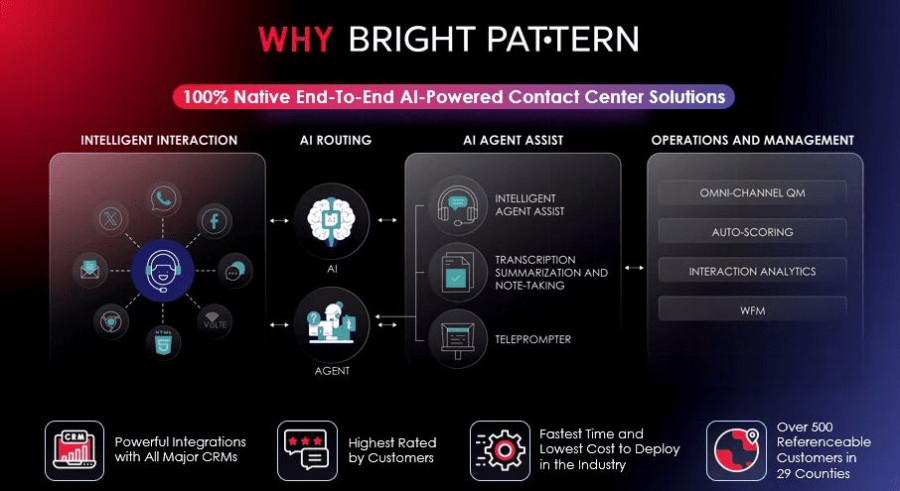
Bright Pattern is a comprehensive AI contact center platform designed to help businesses optimize customer interactions and enhance agent efficiency. It provides tools for virtual agents, omnichannel communication, and AI-driven automation that make it ideal for modern call centers.
Key Features:
- Intelligent virtual agent integration for handling routine and complex queries
- Omnichannel support across voice, chat, email, SMS, and social media
- AI solutions for agents, including real-time guidance and conversation analytics
- Cloud-based infrastructure that scales with your business needs
- Advanced reporting and analytics to monitor performance and improve service delivery
Benefits of Using Bright Pattern:
- Increased agent productivity by automating repetitive tasks
- Faster response times for customer inquiries
- Enhanced customer satisfaction through consistent and personalized experiences
- Seamless integration with existing CRM and business tools
- Flexibility to deploy a virtual agent call center for businesses of all size
2. Genesys Cloud CX
Genesys Cloud CX offers AI-driven solutions for virtual agent call centers, enabling omnichannel customer engagement. Its platform focuses on automation, predictive routing, and workforce optimization.
3. Five9 Cloud Contact Center
Five9 provides cloud-based AI contact center solutions that streamline operations and deliver intelligent virtual agent support. Its tools help manage inbound and outbound communications efficiently.
4. NICE inContact CXone
NICE inContact CXone is designed for virtual agent call centers looking to leverage AI and automation for better customer service. Features include predictive analytics, workforce management, and conversational AI.
5. Talkdesk CX Cloud
Talkdesk offers an AI-powered cloud contact center platform that integrates virtual agents and automation to improve call center efficiency and customer satisfaction.
6. RingCentral Contact Center
RingCentral provides AI contact center tools for virtual agent call centers, with omnichannel support and analytics that help businesses optimize agent performance.
7. Avaya OneCloud
Avaya OneCloud delivers cloud-based contact center solutions with AI enhancements, supporting virtual agents, smart routing, and analytics for improved customer interactions.
8. Cisco Contact Center
Cisco’s AI-enabled contact center platform offers virtual agent capabilities, workflow automation, and real-time analytics to boost operational efficiency.
9. Zendesk Talk
Zendesk Talk integrates AI-driven virtual agents into a user-friendly contact center environment, offering omnichannel support and enhanced customer experience management.
10. 8x8 Contact Center
8x8 provides cloud-based AI solutions for virtual agent call centers, including automation tools, analytics dashboards, and real-time monitoring to improve service delivery.
What Is a Virtual Agent in a Call Center?
Avirtual agentis an AI-powered system that can understand customer questions, respond conversationally, and complete tasks without requiring a human agent to step in for most routine scenarios. In a call center, virtual agents typically interact via:
- Voice (IVR replacement or enhancement with conversational AI)
- Chat (web chat, in-app chat, messaging apps)
- Text-based channels (SMS, social messaging)
Unlike the rigid, menu-driven IVR systems of the past, modern virtual agents use technologies like natural language understanding to interpret what a customer says or types and respond in a more human-like, contextual way.
How a Virtual Agent Call Center Works
Behind the scenes, virtual agents orchestrate a series of intelligent steps to deliver fast, accurate responses.
1. Understanding the Customer
When a customer speaks or types, the virtual agent:
- Captures voice and converts it to text (for voice interactions)
- Usesnatural language understandingto identify the customer intent
- Extracts important details such as names, dates, or account numbers
2. Finding the Right Answer or Action
Next, the virtual agent connects to back-end systems to retrieve information or perform actions, such as:
- Looking up order status, account details, or subscription information
- Updating contact details or preferences
- Scheduling or rescheduling appointments
- Initiating common workflows like password resets or refunds (within policy)
3. Responding to the Customer
The virtual agent then generates a relevant response, which may include:
- Direct answers to questions
- Step-by-step guidance or troubleshooting flows
- Confirmation of completed actions, like payments or changes
For voice conversations, the response is converted back into clear, natural-sounding speech. For chat or messaging channels, it appears as written text, often with quick-reply buttons that streamline the interaction.
4. Handing Off to Human Agents When Needed
One of the biggest strengths of a virtual agent call center is thesmooth escalationwhen automation alone is not enough. In these cases, the virtual agent can:
- Transfer the interaction to a suitable human agent
- Pass along conversation context and data to avoid repetition
- Stay in the background to help the agent with suggested responses or knowledge articles
This blend of virtual and human support creates a more efficient and satisfying experience for everyone involved.
Key Benefits of Virtual Agents in Call Centers
A well-designed virtual agent strategy can transform call center operations. Below are the most compelling benefits organizations typically see.
1. Faster Response Times and 24/7 Availability
Virtual agents can respond instantly, without hold music, queues, or business-hour limitations. This leads to:
- Significantly reduced wait times for customers
- Always-on support, including nights, weekends, and holidays
- Greater coverage during unexpected peaks in demand
Customers receive immediate answers for simple questions, while more complex cases are escalated with less frustration.
2. Lower Operating Costs
By automating high-volume, repetitive inquiries, virtual agents help call centers reduce costs in several ways:
- Handling many more interactions without proportional increases in headcount
- Reducing average handle time when calls do reach human agents
- Lowering training costs for basic queries that no longer require human expertise
The result is a leaner, more scalable operation that can support growth without exploding budgets.
3. Higher First-Contact Resolution
Virtual agents excel at handling standardized processes end-to-end. They do not forget steps, skip verification, or overlook important policies. This consistency often leads to:
- Higher rates of successful resolution on the first interaction
- Fewer callbacks and follow-up contacts
- More predictable and compliant service delivery
4. Improved Customer Satisfaction
When implemented thoughtfully, customers experience virtual agents as fast, convenient helpers rather than obstacles. Satisfaction increases when:
- Customers can self-serve simple needs in seconds
- They are not forced to repeat information during handoffs
- They can choose their preferred channel, from voice to chat to messaging
Combined with more focused, empathetic support from human agents, this hybrid model can lift overall customer experience scores.
5. Better Agent Experience and Retention
Virtual agents do not replace human agents; theysupportthem. By taking over repetitive questions and data lookups, they allow people to focus on more interesting, meaningful work. This can lead to:
- Less burnout from handling the same basic inquiries all day
- More time for complex problem-solving and relationship-building
- Higher job satisfaction and improved retention
Agents also benefit from AI assistance during live interactions, such as suggested next best actions, knowledge retrieval, and automated call summaries.
6. Consistent, Compliant Service
Virtual agents operate based on approved scripts, policies, and workflows. They:
- Always use the latest approved information from knowledge bases
- Follow required steps for verification, disclosures, and compliance rules
- Document interactions in a structured, auditable format
This consistency supports regulatory compliance and reduces errors driven by fatigue or misinterpretation.
Common Use Cases for Virtual Agent Call Centers
Virtual agents can support a wide spectrum of industries and service models. Some of the most common and high-impact use cases include:
Account and Billing Inquiries
- Checking account balances and due dates
- Explaining charges and recent transactions
- Taking payments or processing simple plan changes within policy
Order Management and Logistics
- Providing real-time order status and tracking information
- Updating shipping addresses and delivery preferences
- Initiating returns or exchanges for eligible orders
Technical Support and Troubleshooting
- Guided, step-by-step troubleshooting for common issues
- Password resets and access recovery flows
- Device setup and configuration walkthroughs
Appointments and Reservations
- Scheduling and rescheduling appointments
- Sending reminders and confirmations
- Capturing pre-appointment information and preferences
Proactive Notifications and Outreach
- Proactively alerting customers about service disruptions or delays
- Sending renewal reminders or policy updates
- Following up after service interactions to measure satisfaction
Virtual Agents vs. Traditional IVR: A Quick Comparison
Many organizations start by upgrading from legacy IVR to conversational virtual agents. The differences are significant.
|
Aspect |
Traditional IVR |
Virtual Agent Call Center |
|
Interaction Style |
Menu-driven, rigid options |
Conversational, understands natural language |
|
Customer Effort |
Multiple menus, long sequences |
State the issue in your own words |
|
Personalization |
Limited, generic flows |
Context-aware and personalized responses |
|
Resolution Capability |
Mostly routing, some simple self-service |
End-to-end resolution for many tasks |
|
Adaptability |
Manual reprogramming required |
Can learn and improve over time |
Designing a High-Performing Virtual Agent Call Center
To unlock the full benefits, it is important to design and implement virtual agents strategically. Below are key principles that successful organizations follow.
Start with the Right Use Cases
Focus initially on interactions that are:
- High volume and repetitive
- Rule-based, with clear decision paths
- Low emotional complexity and risk
Examples include order status, simple billing questions, password resets, and appointment management. Quick wins in these areas build internal momentum and customer trust.
Design Conversational Flows, Not Just Scripts
Effective virtual agents are designed aroundnatural conversationsrather than rigid scripts. This includes:
- Allowing customers to express needs in their own words
- Handling clarifications, corrections, and mid-conversation changes
- Providing clear options when the system is uncertain
Thoughtful conversation design makes the experience feel intuitive and human-friendly, even when automation is doing the heavy lifting.
Integrate with Core Systems
To be truly useful, a virtual agent must be able to act on customer requests, not just answer basic FAQs. That usually means integrating with systems like:
- Customer relationship management platforms
- Billing and payment systems
- Order management and logistics platforms
- Knowledge bases and content management systems
These integrations let virtual agents complete tasks, personalize responses, and keep information consistent across channels.
Plan for Seamless Handoffs
Even the most capable virtual agents will encounter situations that require a human touch. Smooth handoffs are essential. Strong designs include:
- Clear triggers for escalation to a human agent
- Passing full conversation history and data to the agent desktop
- Allowing customers to request a human at appropriate moments
When escalation is handled well, customers view automation as an accelerator, not a barrier.
Continuously Monitor and Improve
Virtual agents are not set-and-forget. The most successful call centers treat them as living systems that are continuously improved. This involves:
- Analyzing conversation transcripts and common failure modes
- Updating intents, responses, and flows based on real interactions
- Regularly refreshing knowledge content and FAQs
Over time, this iterative approach increases containment rates, boosts satisfaction, and expands the range of tasks that virtual agents can handle confidently.
Measuring Success in a Virtual Agent Call Center
To demonstrate value and guide optimization, it helps to track a focused set of metrics. Common performance indicators include:
Automation and Containment Metrics
- Containment rate:percentage of interactions fully handled by the virtual agent without human intervention
- Deflection:reduction in call or chat volume handled by human agents
- Task completion rate:percentage of automated tasks successfully completed
Experience Metrics
- Customer satisfaction (CSAT):feedback on automated and hybrid interactions
- Net Promoter Score (NPS):overall loyalty impact over time
- Customer effort score:how easy it is to resolve issues through the virtual agent
Operational and Financial Metrics
- Average handle time (AHT):impact on interaction duration for human agents
- Cost per contact:reduction driven by automation
- Agent productivity:number of complex cases handled per agent
Tracking these metrics creates a clear picture of how virtual agents support both customer experience and operational efficiency.
Building a Future-Ready Call Center with Virtual Agents
The call center of the future is not fully human or fully automated. It is ahybrid environmentwhere virtual agents, human agents, and smart workflows combine to deliver fast, friendly, and consistent service across every channel.
By introducing virtual agents thoughtfully, starting with high-value use cases, and continuously refining the experience, organizations can:
- Delight customers with instant, 24/7 support
- Empower agents to focus on strategic, meaningful work
- Operate more efficiently and scale with confidence
Virtual agents are no longer a futuristic concept. They are a practical, proven way to transform the call center from a cost center into a powerful engine of customer loyalty and long-term growth
